
Place Seffarine and the coppersmiths
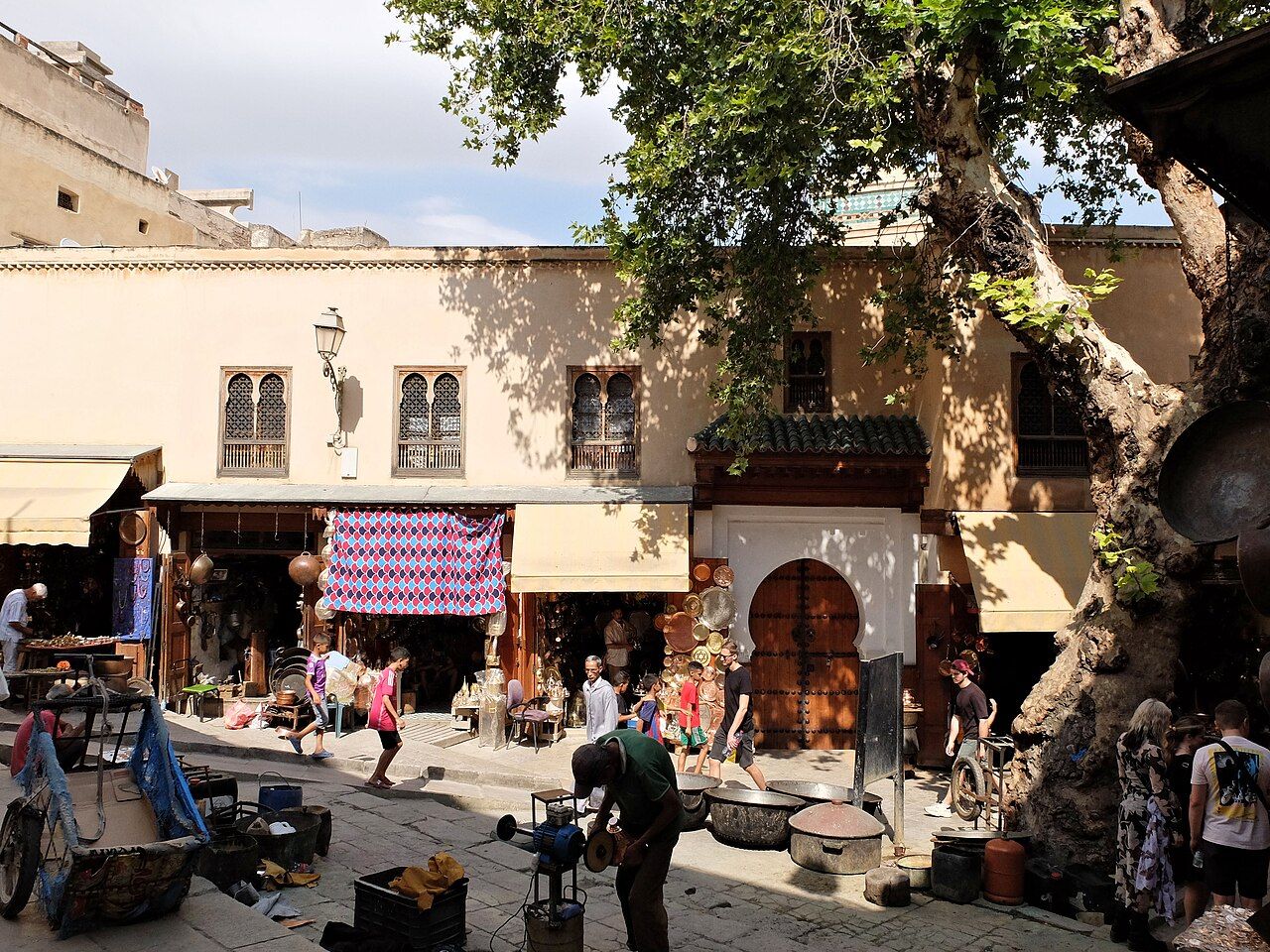
In a small triangular square near the heart of Fès, metalworkers beat copper and brass into cauldrons and trays under a great plane tree. You hear it long before you see it.
- From Bab Bou JeloudAbout thirty-five minutes downhill on foot
- PaceEasy
- The way inDownhill past al-Qarawiyyin's southern side
- BringEarplugs if sensitive, small change, curiosity
Somewhere below the great mosque of al-Qarawiyyin, the lanes open into a small, irregular square, and the air rings with hammering. This is Place Seffarine, the square of the coppersmiths. Men sit among piles of copper and brass, beating sheets of metal into pots, trays and cauldrons, while a huge plane tree shades part of the square. It is one of the most atmospheric places in the medina, and one of the easiest to find by ear.
The square and its sound
"Seffarine" comes from the Arabic word for brass and copper workers, and metalworkers have gathered here for centuries. The square is small and roughly triangular, enclosed by walls and shopfronts, with lanes leading off towards the mosque, the river and the dyers' quarter. A large tree grows at one side, its trunk thick and pale, and gives welcome shade on hot days.
The sound is the first thing you notice. Coppersmiths work with hammers of different sizes, each giving a different note. Several men working at once create a clatter that carries through the surrounding lanes. Some visitors find it overwhelming; others find it musical. Either way, it is one of the defining sounds of old Fès.
Cauldrons, trays and how they are made
The coppersmiths of Seffarine make objects for both everyday use and special occasions. Look around the square and you may see:
- Large cauldrons. Huge pots used for cooking at weddings and festivals, sometimes big enough for a person to sit in. Some are made new; others are brought in for repair or rental.
- Trays. Round trays of copper or brass, plain or engraved, used for serving tea and food.
- Kettles and pots. Smaller vessels for the kitchen and for washing.
- Decorative work. Lanterns, bowls and other items, often engraved or pierced with patterns.
The technique is mostly hammering. A sheet of metal is shaped over a form or anvil, then beaten gradually into a curve. Seams are joined and smoothed. Larger items may be heated to make the metal easier to work. Engraving and piercing are done with small chisels and punches. Repair is part of the trade too: dents are knocked out, handles replaced, surfaces polished.
Watching is generally welcome, as long as you keep out of the way. If you are interested in buying, you can ask, and bargaining is expected. But there is no pressure to buy simply because you have stopped to look.
The Seffarine madrasa
Close to the square stands the Seffarine madrasa, one of the oldest colleges in Fès. It was built by the Marinids in the late thirteenth century, decades before the more famous al-Attarine and Bou Inania. Compared with those, it is simpler and less decorated, and it was built in a different style, closer to a large house than a monumental courtyard.
The madrasa has been restored in recent years and has long served as a residence for students. Visitor access has varied; at times you can look into the courtyard, at other times the door is closed. If it is open, step in quietly and respect the fact that people may be living and studying there.
Close by: Fès blue: pottery and zellige
The library's gate
On one side of the square is the entrance to the library of al-Qarawiyyin. The building presents a calm white façade, with a large arched doorway, carved wooden eaves under green tile, and zellige panels flanking the entrance. Small plaques beside the door record its history.
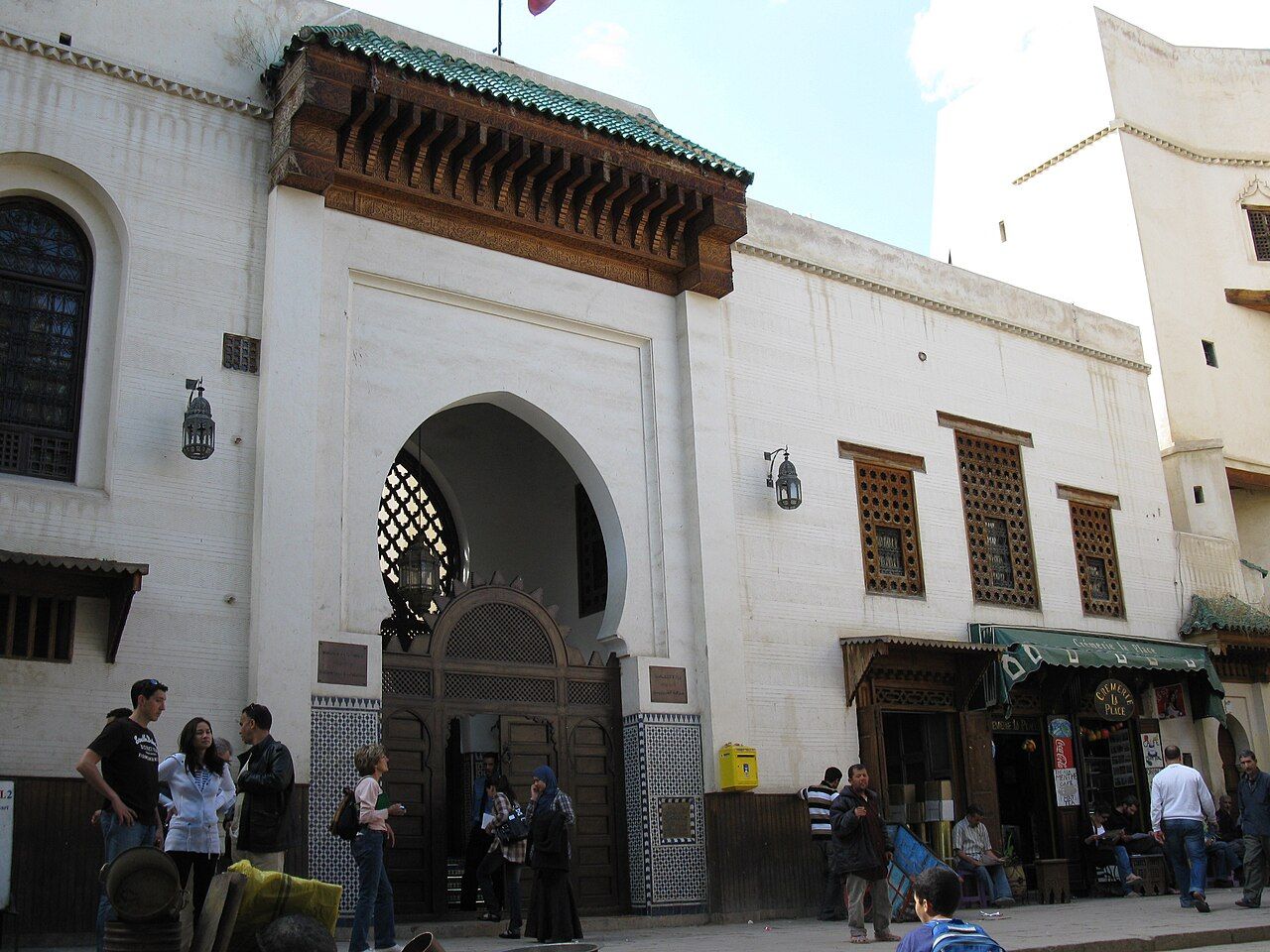
The library was founded in the fourteenth century by the Marinid sultan Abu Inan, the same ruler who built the Bou Inania madrasa. It holds an important collection of manuscripts and was restored in the 2010s, with new facilities for conservation. Access for general visitors is limited, but the façade is worth a look, and it marks the southern side of the great mosque complex. For more on the mosque and university, see al-Qarawiyyin from its doorways.
The juxtaposition is striking: on one side, the hammering of craftsmen at work; on the other, the quiet entrance to one of the oldest libraries in the Islamic world. Both have been part of the square's life for centuries.
Combining Seffarine with nearby sights
Place Seffarine sits at a crossroads of the lower medina, which makes it a natural hub for a morning of exploring. From here:
- The great mosque is a few steps away, with its doors and the library entrance around the square.
- The dyers' lane lies downhill towards the river. See the dyers' street and the looms.
- The Chouara tannery is a short walk to the north-east, through lanes lined with leather shops. See the Chouara tannery from above.
- The river and the Andalusian quarter lie further east, across one of the bridges.
Many walking routes through the lower medina pass through Seffarine, so even if you do not plan to stop, you are likely to cross it. It is an easy landmark to ask for if you are lost.
Mid-morning hammering
The square is most alive during working hours, from mid-morning through the afternoon. Early in the morning and on Fridays, many workshops are quiet or shut, and the square can feel empty. During Ramadan the daytime pace slows and hours shift.
Around the anvils:
- Protect your ears if you need to. The noise is loud, especially when several smiths are working at once.
- Watch for sparks and metal. Some work involves heat and sharp edges; keep a respectful distance.
- Ask before photographing people. The square is very photogenic, but the craftsmen are working.
- Bargain politely. If you want to buy, prices are negotiable, and there is no fixed rate.
Seffarine shows a side of Fès that is easy to miss if you only visit museums and monuments. It is a working square, loud and practical, and it has been that way for a very long time.