
The dyers' street and the looms
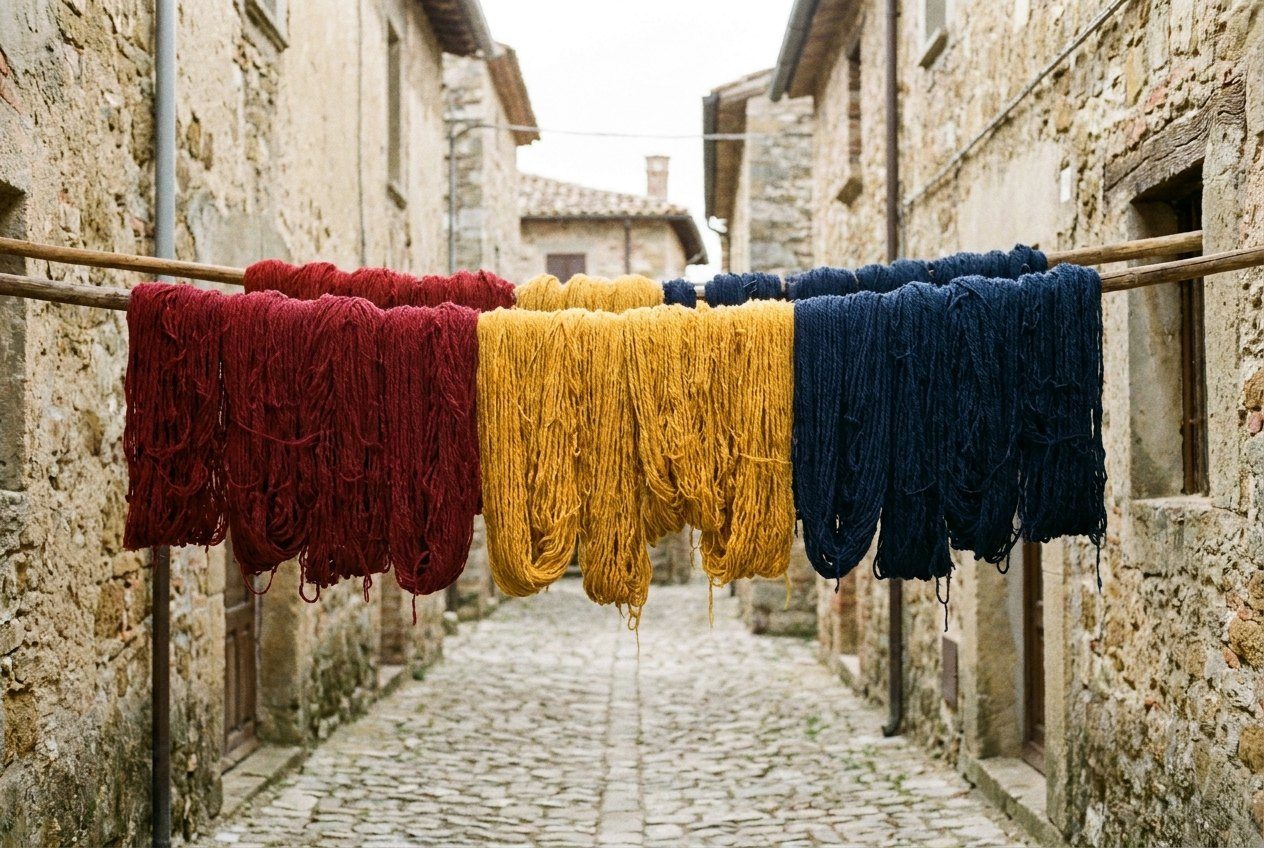
Close to the river, wool and silk hang dripping above a narrow lane, and behind small doorways men pass shuttles across wooden looms. It is one of the most colourful corners of the medina.
- From Bab Bou JeloudAbout forty minutes downhill on foot
- PaceHalf day
- The way inDownhill towards the river, near Seffarine
- BringShoes you can get dye-splashed, small change
The tanneries get the crowds, but the dyers of Fès make one of the most striking sights in the medina. In a narrow lane near the river, freshly dyed skeins of wool and silk hang from poles and beams overhead, dripping onto the stones below. Nearby, behind modest doorways, weavers sit at wooden looms and turn that yarn into cloth. Together they show a craft chain that has run through the city for centuries.
Where the dyers work
The dyers' quarter lies in the lower part of Fès el-Bali, close to the river that runs through the medina and not far from the coppersmiths of Place Seffarine. Its location is no accident. Dyeing needs large amounts of water, both for the vats and for rinsing, and for centuries the river and the city's channels supplied it.
The lane is easy to recognise once you are in it. The walls are stained with old splashes of colour, the ground can be wet underfoot, and above you hang bundles of yarn in deep red, saffron yellow, indigo, green and purple. Workers lift skeins out of steaming vats with sticks, wring them, and hang them up to dry. It is a working street, and it is busy during the day.
Finding it can take a little patience, as signs are few. If you ask for the dyers' souk near Seffarine, people will usually point you in the right direction. Our guide to Place Seffarine and the coppersmiths describes the square that makes a good starting point.
How the dyeing works
The basic process is simple, though doing it well takes years of practice. Yarn, usually wool or silk, sometimes cotton, is washed and then immersed in large vats of hot dye. The dyer works it with a stick to make sure the colour takes evenly, lifts it out to check the shade, and repeats as needed. Then the yarn is rinsed, wrung and hung to dry.
Traditionally the dyes were natural, drawn from plants, roots, bark, insects and minerals. Indigo gave blue; madder root and other materials gave reds; various plants gave yellows. Today many dyers use synthetic dyes as well, which are cheaper and more consistent, but the methods of handling the yarn have changed little.
The dyers often work for weavers and other craftsmen, colouring yarn to order. What you see drying above the lane may end up in carpets, scarves, blankets or the fabric of a jellaba.
The weavers at their looms
In small rooms off the lanes of the medina, weavers work at narrow wooden looms. Many are treadle looms, operated with the feet to lift and lower sets of threads while the weaver passes a shuttle across with the hands. The rhythm is steady and quick: a clack of the treadles, the swish of the shuttle, the thud of the beater pressing each thread into place.
The cloth produced is typically in long, narrow strips. Weavers make scarves, shawls, blankets and lengths of fabric for clothing, in wool, cotton, silk or blends. Patterns range from plain stripes to more complex designs. Many workshops are small, sometimes a single loom in a single room, and the trade is often passed down within families.
If a weaver is at work and the door is open, it is usually fine to stop and watch for a moment. Some workshops welcome visitors and may show you how the loom works; others are simply busy. Ask before taking a photograph of anyone, and be prepared to move on.
Close by: Dar Batha and its Andalusian garden
What "cactus silk" means
As you walk through the medina you will often hear the phrase "cactus silk" or see it on labels. Known locally as sabra, it is said to be a fibre made from the leaves of the agave plant. Agave fibre does exist, and it has long been used in North Africa for cords, ropes and some textiles.
However, much of the shiny, brightly coloured "cactus silk" sold to visitors is in fact viscose or rayon, a manufactured fibre made from plant cellulose. It can look very similar, with the same lustre and range of colours. It is not necessarily a scam, as viscose is plant-derived, but it is not hand-processed agave, and it is fair to ask what you are buying.
Some simple points to keep in mind:
- Genuine agave fibre is usually stiffer and coarser than the soft, smooth scarves on many stalls.
- Price is a clue. Hand-processed natural fibre takes a great deal of work and is rarely cheap.
- Ask the seller directly. Many will answer honestly if you ask clearly.
- Buy what you like for its own sake. A well-made viscose scarf can still be a good purchase if the price matches what it is.
Watching rather than buying
The dyers' street is a place to look. Some workers may offer to sell you skeins, scarves or small items, or direct you to shops nearby, but there is no expectation that you buy anything. A smile and a "no, thank you" is enough.
A few habits help:
- Watch your clothes. Drips of dye from overhead yarn can stain. Wear something you do not mind marking, and look up before you pause under a hanging skein.
- Mind the ground. The stones can be wet and slippery, and carts and porters come through.
- Do not get in the way. The dyers are working with hot liquids and heavy wet yarn. Keep to the side.
- Ask before photographing people. The hanging yarn is the easy subject; the workers deserve the courtesy of a question first.
Unofficial guides may offer to take you to a "cooperative" or a weaving shop. You are free to decline. If you do follow someone into a shop, you are under no obligation to buy.
A morning of working crafts
The dyers' lane fits naturally into a morning in the lower medina. Start at Place Seffarine, where coppersmiths hammer metal in the open, then walk down to the dyers by the river. From there it is not far to the Chouara tannery, where hides go through a different kind of dyeing in stone pits.
If you have time, continue to Place Nejjarine, where the carpenters work in cedar and a museum shows the history of woodwork. Each of these crafts depends on the others: dyed wool for weaving, leather for babouches and bags, copper for cooking pots and trays, cedar for doors and ceilings. Seen together, they show how the medina has always worked as a single large workshop, organised by street and by trade.
The best time for all of them is the morning, when the workshops are active and the light reaches into the lanes. On Fridays and during religious holidays many close, and in Ramadan hours shift.