
Fès blue: pottery and zellige
The blue of Fès is a glaze before it is a gate. Outside the old walls, potters and tile cutters still make the ceramics and mosaics that cover the city.
- From Bab Bou JeloudFifteen minutes by petit taxi
- PaceHalf day
- The way inPetit taxi towards Bab Ftouh
- BringClosed shoes, small change, an eye for detail
Look closely at almost any surface in Fès and you will find tile. It lines the bases of courtyard walls, frames fountains, clads the gates and covers tables and floors. The city has a long tradition of ceramics, and two crafts in particular define it: the blue-and-white pottery known as Fassi blue, and zellige, the mosaic of hand-cut tile pieces that decorates so many buildings. Both are still made in and around the city.
The potters' quarter
Pottery was long made outside the medina walls, because kilns produce smoke and need space. The main potters' quarter lies to the south-east of the old city, beyond Bab Ftouh, in an area known as Ain Nokbi. Here workshops make plates, bowls, tagines, tiles and other ceramics, from clay preparation to firing.
The process follows familiar steps. Clay is soaked, cleaned and kneaded. Potters throw pieces on wheels, often foot-powered, or shape them in moulds. Pieces are dried, fired a first time, then glazed and decorated, and fired again. Traditional kilns burned wood and other fuels, and in recent decades efforts have been made to move to cleaner gas kilns to reduce smoke.
If you visit, wear sturdy shoes, as the ground can be uneven and dusty. Some workshops welcome visitors to watch; others are simply busy. Ask before entering, and ask again before photographing anyone at work.
Fassi blue
The signature of Fès pottery is a deep cobalt blue on a white ground. Designs include geometric patterns, floral motifs and fine lines, painted by hand onto glazed pieces before the final firing. The blue has long been associated with the city, and it appears on everything from small bowls to large serving dishes.
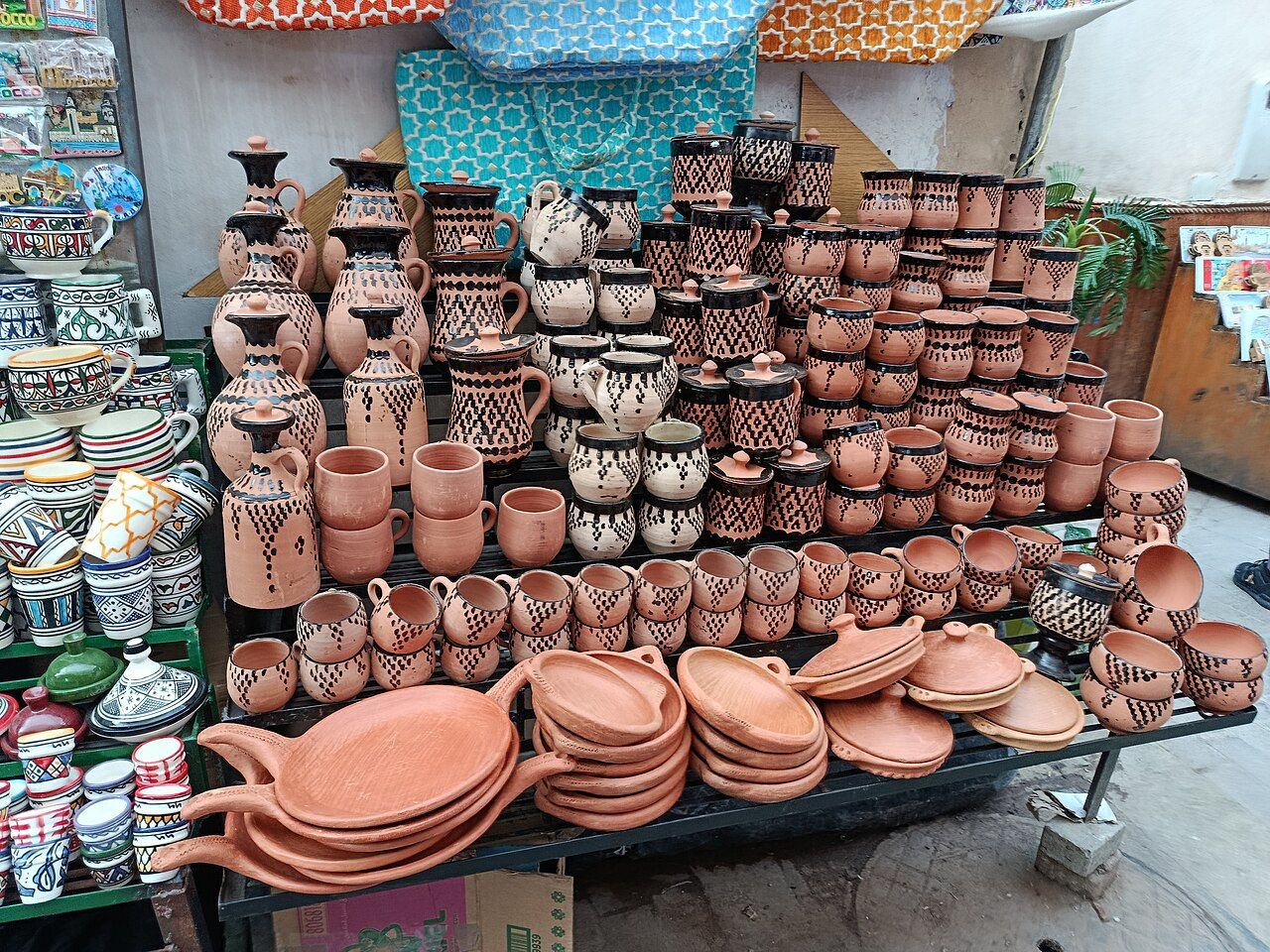
Today potters in Fès work in many colours, including greens, yellows, browns and polychrome designs, and much of what you see for sale is brightly decorated. Earthenware tagines and water jars are often left plain or partially glazed, with patterns of dark dots or lines. Blue and white remains the classic, and it is worth looking for.
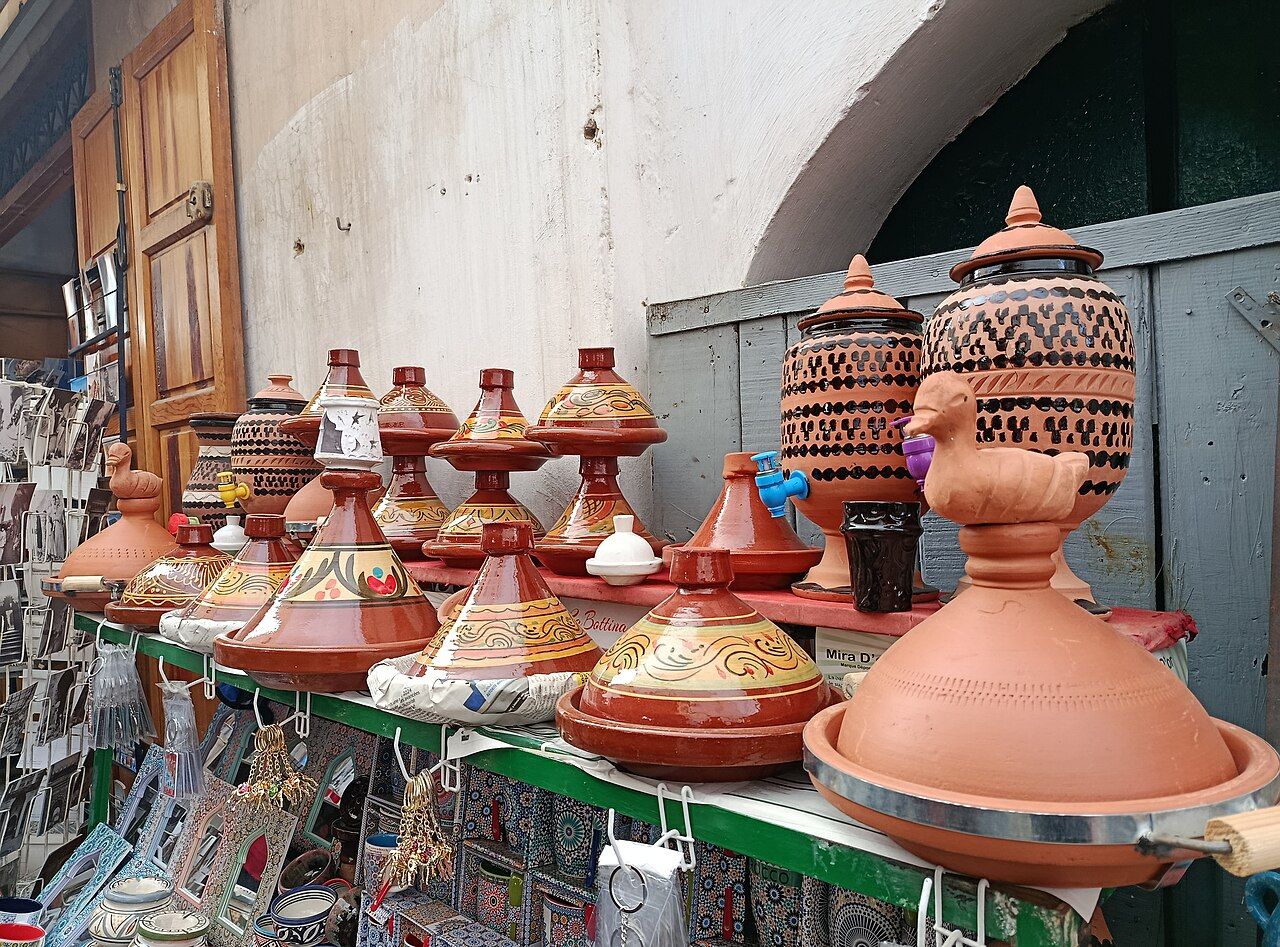
Quality varies widely. Well-made pieces are evenly glazed, with clean lines and careful painting; cheaper ones may be lighter, thinner and painted quickly. Some decorated pieces are made for display rather than cooking, so ask if you intend to use a tagine on heat.
Zellige, cut by hand
Zellige is a different craft. Rather than painting a pattern onto one tile, craftsmen assemble patterns from many small pieces of single-coloured glazed tile. The result is a mosaic of stars, polygons and interlocking shapes, often in green, blue, white, black, yellow and brown.
The work begins with square tiles, each glazed in a single colour and fired. A cutter then shapes them into small pieces using a sharp hammer-like tool, chipping away at the edges until each piece matches a template. The pieces are bevelled on the back so they fit tightly together. It is precise, repetitive work, and skilled cutters can produce many pieces a day.
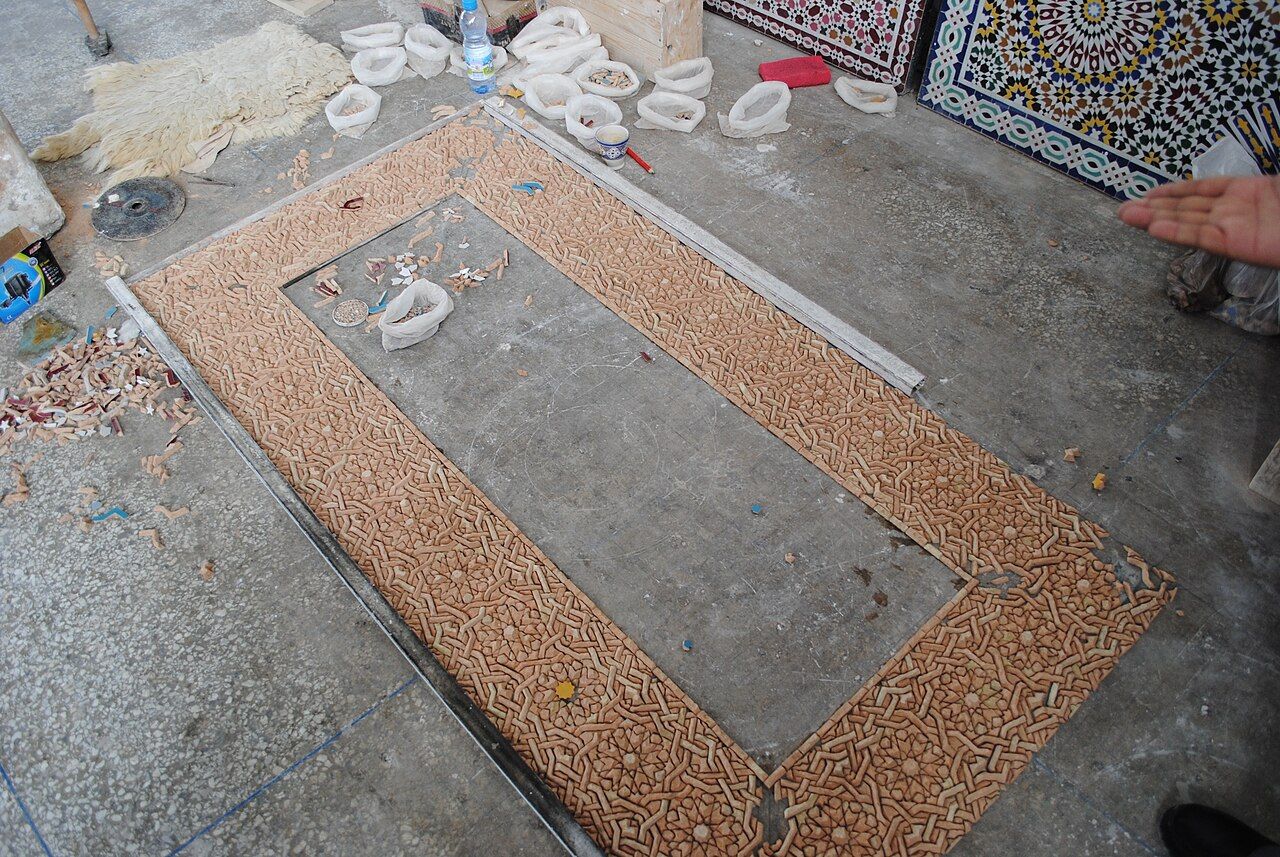
Assembly is done face down. Craftsmen lay the pieces upside down on a flat surface, following a pattern that they hold largely in memory, then pour a layer of plaster or cement over the back. When it sets, the panel is lifted and turned over to reveal the design.
Close by: The brass gates of the Royal Palace
The photograph at the top of this story shows a border being assembled this way, with sacks of cut pieces ready nearby. Zellige panels made like this cover the walls of madrasas, palaces, fountains and houses. You can see some of the finest historic work in the Bou Inania madrasa, and in the courtyards described in our piece on the riad.
Watching rather than buying
Pottery and zellige are both sold widely in Fès, from small stalls in the medina to larger showrooms. Buying is not required to enjoy the craft. Some ways to appreciate it:
- Visit a workshop. Watching a potter at the wheel or a zellige cutter at work shows the skill involved.
- Look at historic examples. Museums such as Dar Batha hold collections of old Fès ceramics, including fine blue-and-white pieces.
- Notice tile in daily life. Fountains, doorways and gates across the city show zellige of many periods and styles.
If you do buy, take time to compare and bargain politely. Pottery is fragile and heavy, so think about how you will carry it home. Some sellers offer to ship larger items; check the details carefully before agreeing.
Modern twists
The crafts are not frozen in time. Alongside traditional forms, you will find modern objects decorated with zellige patterns or Fassi motifs: insulated bottles, phone cases, coasters, mirrors and souvenirs. Some are made by hand; many are printed or mass-produced. They show how the visual language of Fès has spread into everyday objects.
Meanwhile, zellige is in demand for buildings in Morocco and abroad, and craftsmen from Fès work on projects far from the city. Training programmes and cooperatives help pass on the skills.
Out past Bab Ftouh
- Taxi or on foot. The potters' quarter is outside the walls, best reached by petit taxi or on foot from Bab Ftouh. Ask a driver for the pottery area.
- Timing. Workshops are busiest on weekday mornings. Many are closed or quiet on Fridays.
- Respect. These are working spaces with heavy materials, sharp tools and hot kilns. Keep a safe distance.
- Prices. They vary greatly and are negotiable; we give none here.
The blue of Fès is everywhere once you start looking for it. Seeing how it is made adds another layer to every gate, fountain and courtyard you pass.