
Al-Attarine, the perfumers' madrasa
Down at the busy heart of the medina, beside the spice and perfume market, a small fourteenth-century college packs remarkable detail into a single courtyard.
- From Bab Bou JeloudTwenty-five minutes downhill on foot
- PaceEasy
- The way inDown Talaa Kebira to the spice market
- BringModest clothing, small change, time to look closely
By the time Talaa Kebira and Talaa Seghira come together near the bottom of the medina, the lanes are at their busiest. Spice sellers, perfume stalls and shoppers press together, and you might walk past the entrance of the al-Attarine madrasa without noticing. Look for a doorway clad in metal, then step inside. The noise falls away, and a small courtyard of extraordinary richness opens up.
A college by the spice market
The madrasa takes its name from the Souk al-Attarine, the market of the perfumers and spice dealers, which has stood in this part of Fès for centuries. It was built in the 1320s by the Marinid sultan Abu Said Uthman, a generation before the larger Bou Inania further up the hill.
Its position mattered. The madrasa stands very close to the great mosque of al-Qarawiyyin, which was already the centre of learning in the city. Students who lived here could walk a few steps to lectures in the mosque, then return to their rooms around this quiet court. The market outside paid, in a sense, for the scholarship inside: Marinid foundations were often supported by income from shops and properties.
The bronze door
The entrance is your first clue to the quality inside. The main door is covered in bronze, worked into patterns and fitted with heavy knockers. Doors like this, clad in metal and decorated with geometric designs, were a mark of prestige in Marinid Fès, and similar doors guard other great buildings in the medina.
Beyond the door a short passage leads into the courtyard. The turn is deliberate. As in many Moroccan buildings, you do not see straight inside from the street, which keeps the courtyard private and makes the moment of arrival more striking.
A small courtyard, densely made
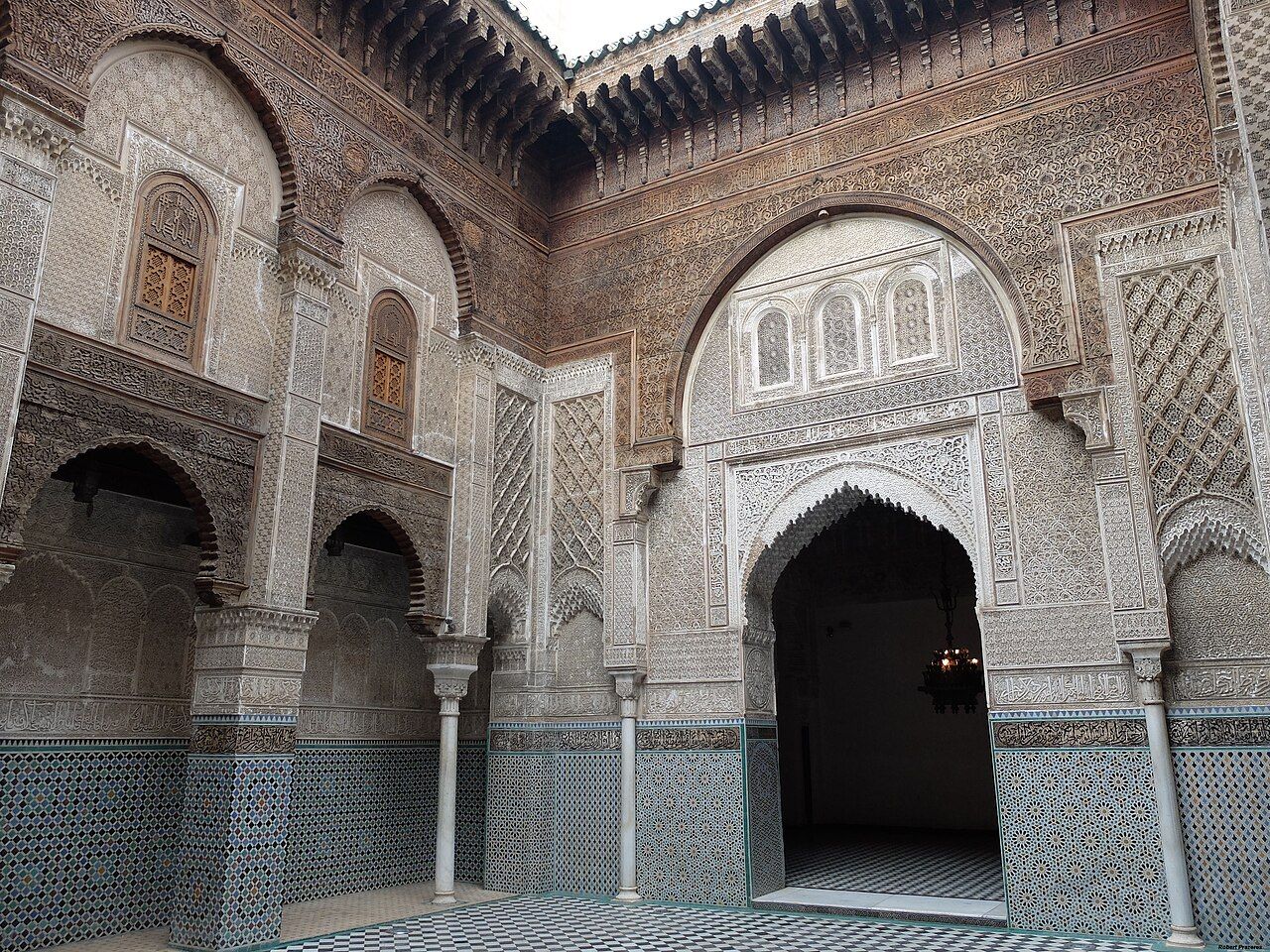
The courtyard is rectangular and modest in size, paved in tile, with a basin for water at its centre. What makes it remarkable is how much decoration it holds and how well the parts fit together.
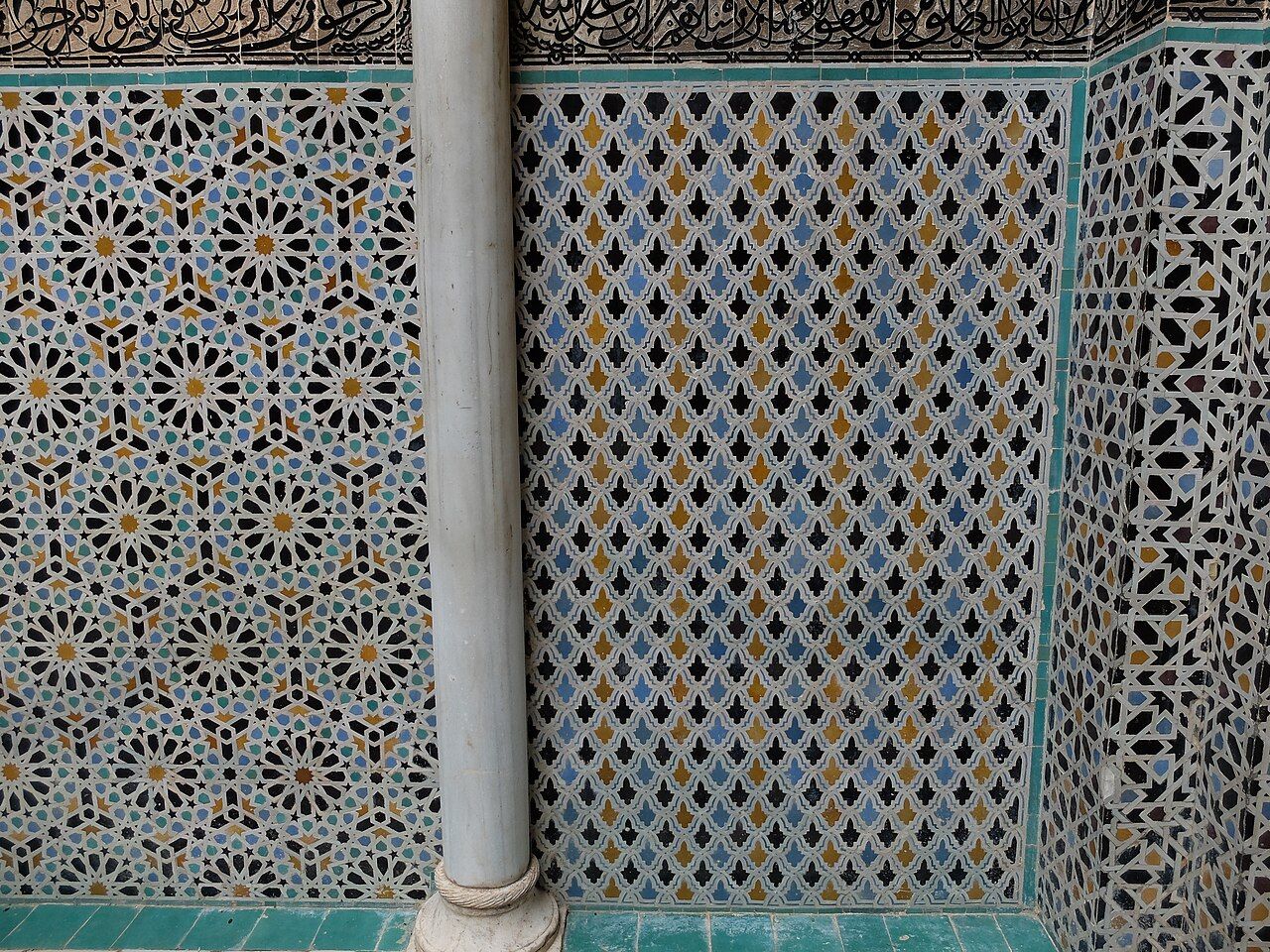
- Zellige. The lower walls are lined with mosaic tile in several patterns, from stars and interlocking polygons to a fine trellis of small pointed shapes. A band of tiled inscription runs above them.
- Slender columns. Thin marble columns stand along the sides, an unusual touch that gives the court a lighter, more delicate feel than many contemporary buildings.
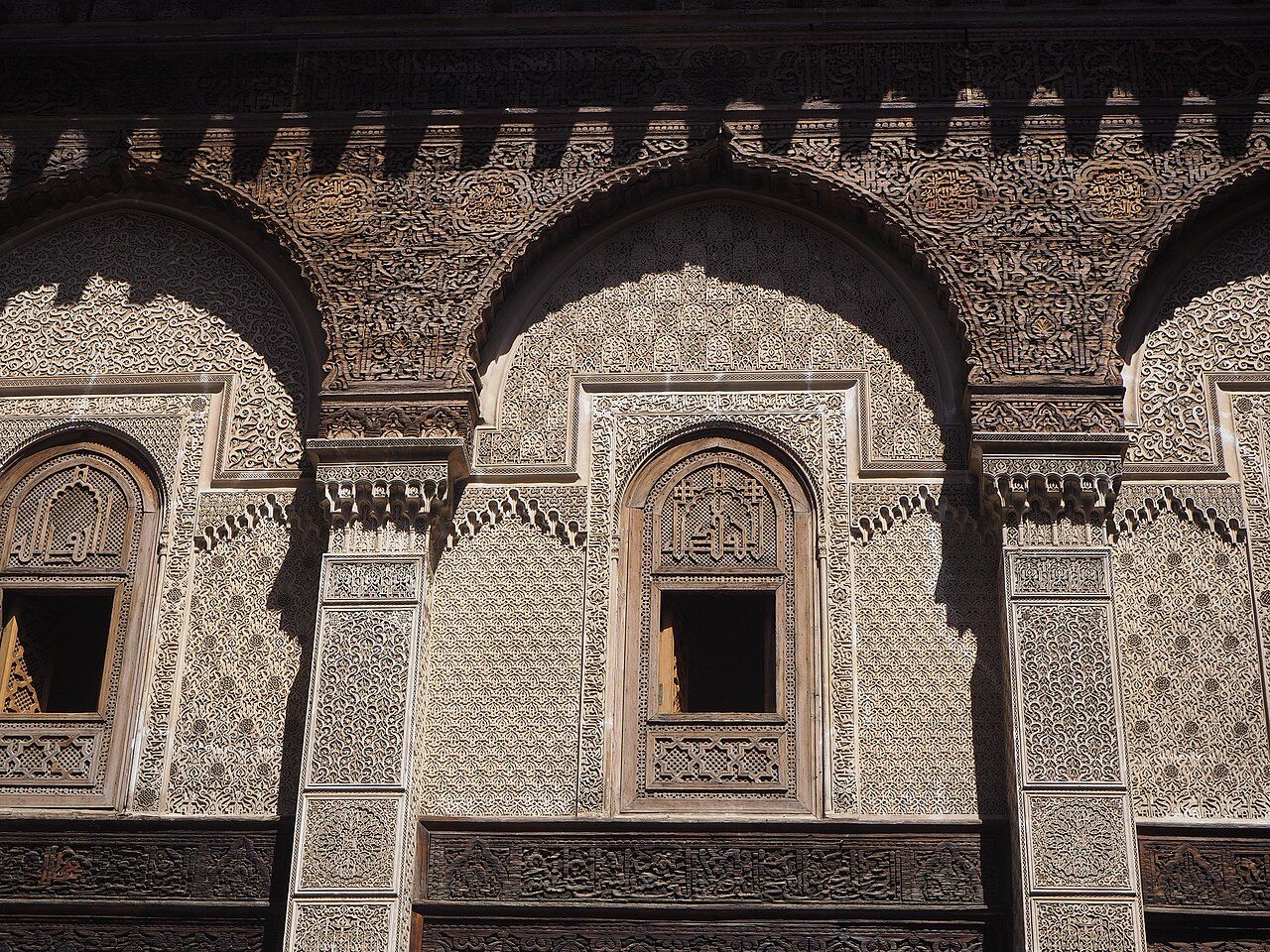
- Stucco. Above the tile, carved plaster covers the walls in arches, panels and inscriptions, so fine in places that it reads like textile.
- Cedar. The upper walls and eaves are carved cedar, with deep brackets and friezes, and wooden screens filling the windows of the upper floor.
At the far end, a large arch opens into the prayer hall, with a lamp hanging from the ceiling. Students' rooms are on the upper floor, reached by stairs, and they are small and plain, a reminder that this was a place to live and work as well as a work of art.
Close by: Nejjarine square, fountain and woodwork
Looking towards al-Qarawiyyin
Because the madrasa stands so close to the great mosque, its upper level has long offered a view across to the mosque's green-tiled roofs and courtyard area. For non-Muslims, who cannot enter the mosque, that glimpse from above has been one of the few ways to sense its scale.
Access to the upper floors and roof has varied over the years. Sometimes visitors can climb; sometimes the stairs are closed for conservation or safety. If you can go up, take your time and look for the long sloping roofs of green tile. If not, the doorways of al-Qarawiyyin itself are a short walk away and give a different, ground-level view.
Comparing the two great madrasas
If you have already seen the Bou Inania madrasa near Bab Bou Jeloud, al-Attarine makes an interesting contrast.
| Al-Attarine | Bou Inania | |
|---|---|---|
| Built | 1320s | 1350s |
| Location | Centre of the medina, by the spice market | Top of Talaa Kebira, near the western gate |
| Scale | Small, intimate courtyard | Larger court with a minaret |
| Character | Delicate, densely detailed | Grand and monumental |
Many visitors find al-Attarine the more beautiful of the two, precisely because it is so compact. Everything is close enough to examine, and the craftsmanship is at eye level. Seeing both on the same day, one at the top of the hill and one at the bottom, is an easy way to train your eye for the details that recur across the city.
Hours around Friday prayers
The madrasa is open to visitors at set times, usually through the day, with an entrance fee. Hours shorten on Fridays and may change during Ramadan or for religious occasions. The building has been restored in recent years, and it still closes now and then for work.
- Go early. The courtyard is small, and a single group can fill it. The first hour after opening is calmest.
- Dress modestly. As at any religious building, cover shoulders and knees.
- Look up and down. The best details are often in the cedar eaves and in the tile at floor level, both easy to miss.
- Walk on. From here it is a few minutes to the coppersmiths of Place Seffarine, and the spice market outside is worth a slow pass on the way.
When you step back out through the bronze door into the crowd, the contrast is part of the experience. Fès keeps its finest rooms behind plain walls, and al-Attarine is a perfect example of that habit.