
Bab Bou Jeloud, the blue gate
The most photographed doorway in Fès is younger than it looks, and it frames the old city like a stage set. Here is how to use it as your starting line.
- From Bab Bou JeloudYou are already standing at it
- PaceEasy
- The way inPetit taxi to the gate, then walk
- BringSmall change, comfortable shoes, a sense of direction
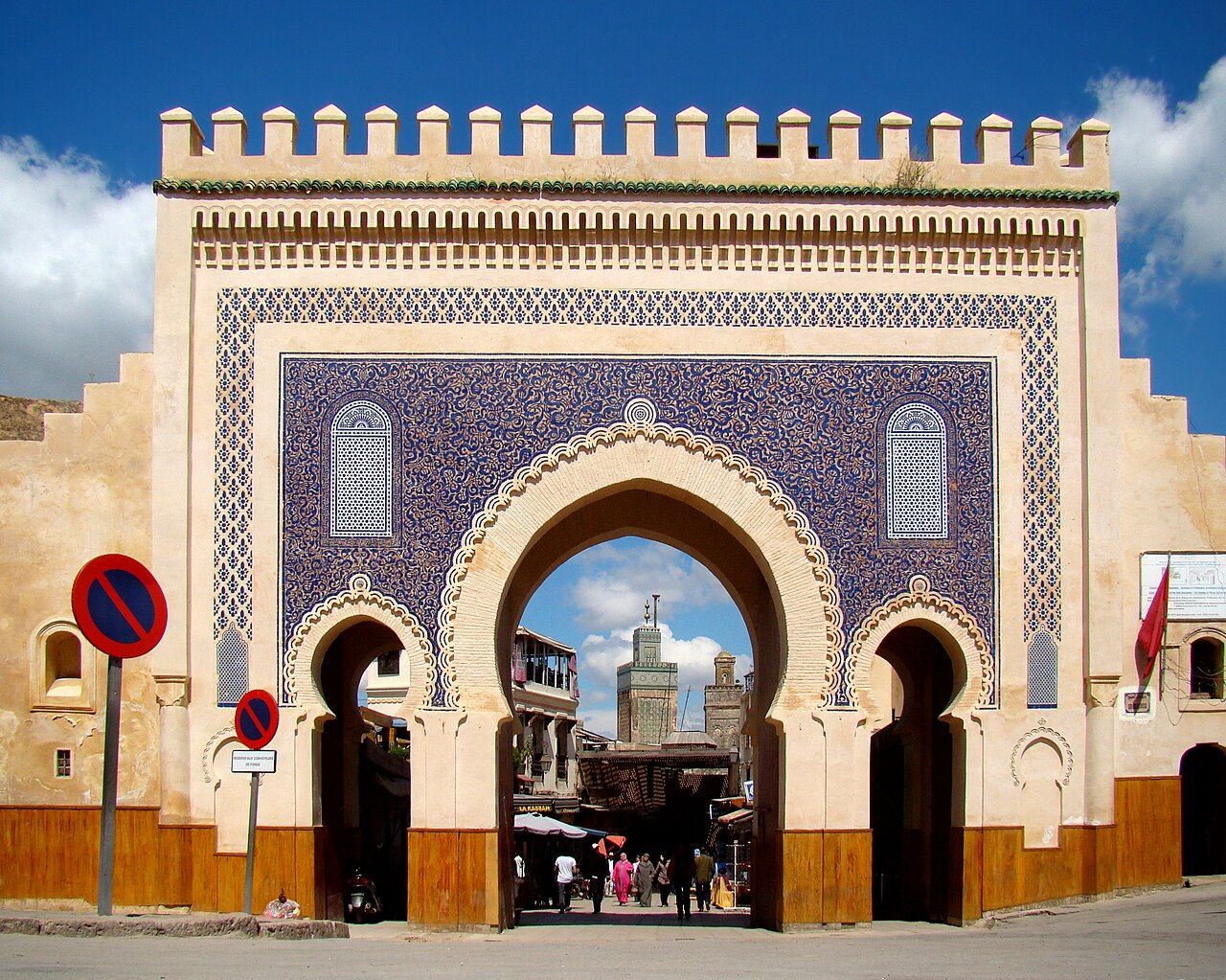
Almost every first walk into Fès el-Bali begins in the same place: a broad square on the western edge of the old city, a crenellated wall, and a triple arch faced with tiles the colour of deep water. Bab Bou Jeloud is not the oldest gate in Fès, nor the largest, but it is the one that tells you where you are. Stand in front of it for a minute before going through. The gate explains a good deal about the city behind it.
A gate younger than it looks
The tiled gate you see today dates from the early twentieth century, built around 1913, during the first years of the French protectorate. An older, plainer entrance stood close by. The builders of the new gate took the vocabulary of much older Moroccan gates (horseshoe arches, a frame of carved plaster, merlons along the top like the teeth of a comb) and wrapped it in glazed tile.
That recent date does not make it a fake. The craftsmen who cut and set the tiles worked in the same tradition as the makers of the medina's madrasas and fountains, and the gate has been part of the city's daily life for more than a century. It is simply a reminder that Fès has never stopped building. The whole of the old city, listed as a UNESCO World Heritage Site since 1981, is a living place rather than a museum piece.
Blue on one side, green on the other
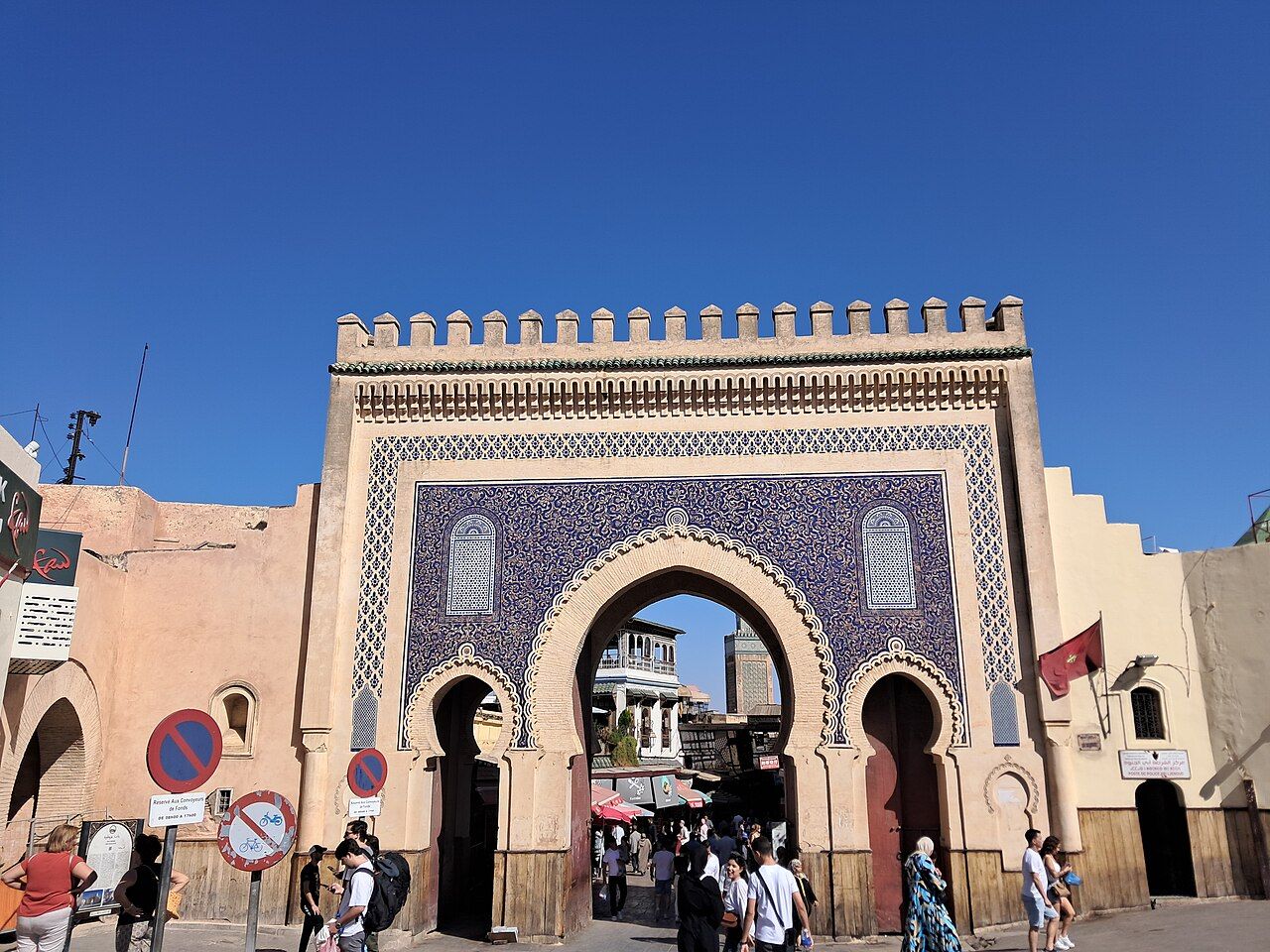
The outer face is blue, a dense pattern of flowers and interlacing stems set in cobalt tile. Blue is often called the colour of Fès, the same shade you find on the city's traditional pottery. Walk through the central arch and turn around, and the inner face is green, the colour most closely tied to Islam. The two faces are a neat piece of symbolism: the city presents one colour to arriving travellers and another to its own people.
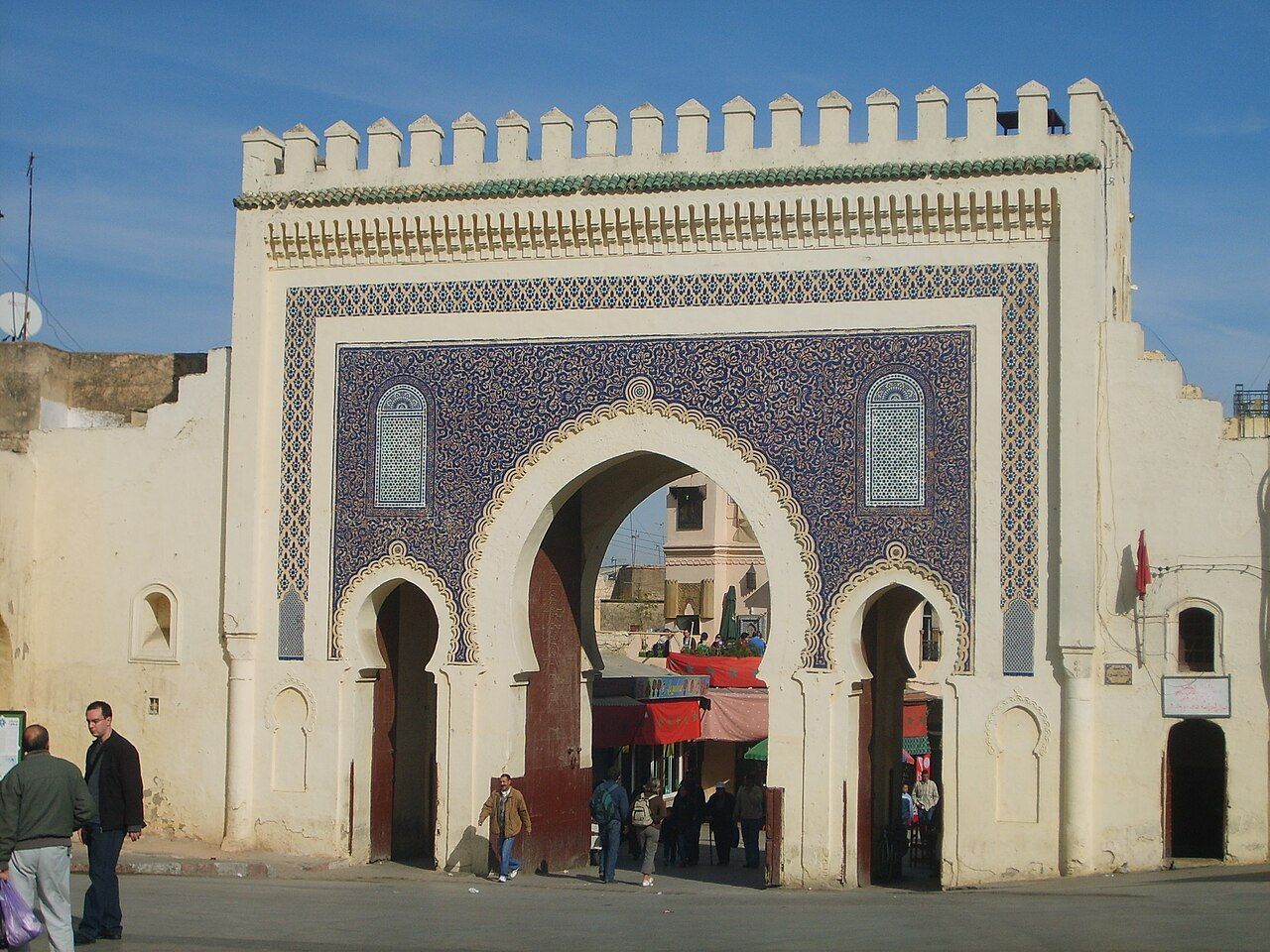
Look up as well as across. Above the tiles runs a band of carved plaster, and above that a strip of green roof tiles and the merlons. The two small arched windows set into the blue field are filled with fine geometric lattice. The two side arches are lower and narrower than the central one, and they give the façade its balance.
The view through the central arch is part of the design, whether planned or not. Framed inside it you see a slim minaret or two rising above the rooftops, one of them belonging to the Bou Inania madrasa a few steps down the hill. Photographers wait for the moment when the street beyond is clear; in practice it rarely is, and the crowd is part of the picture.
The square in front
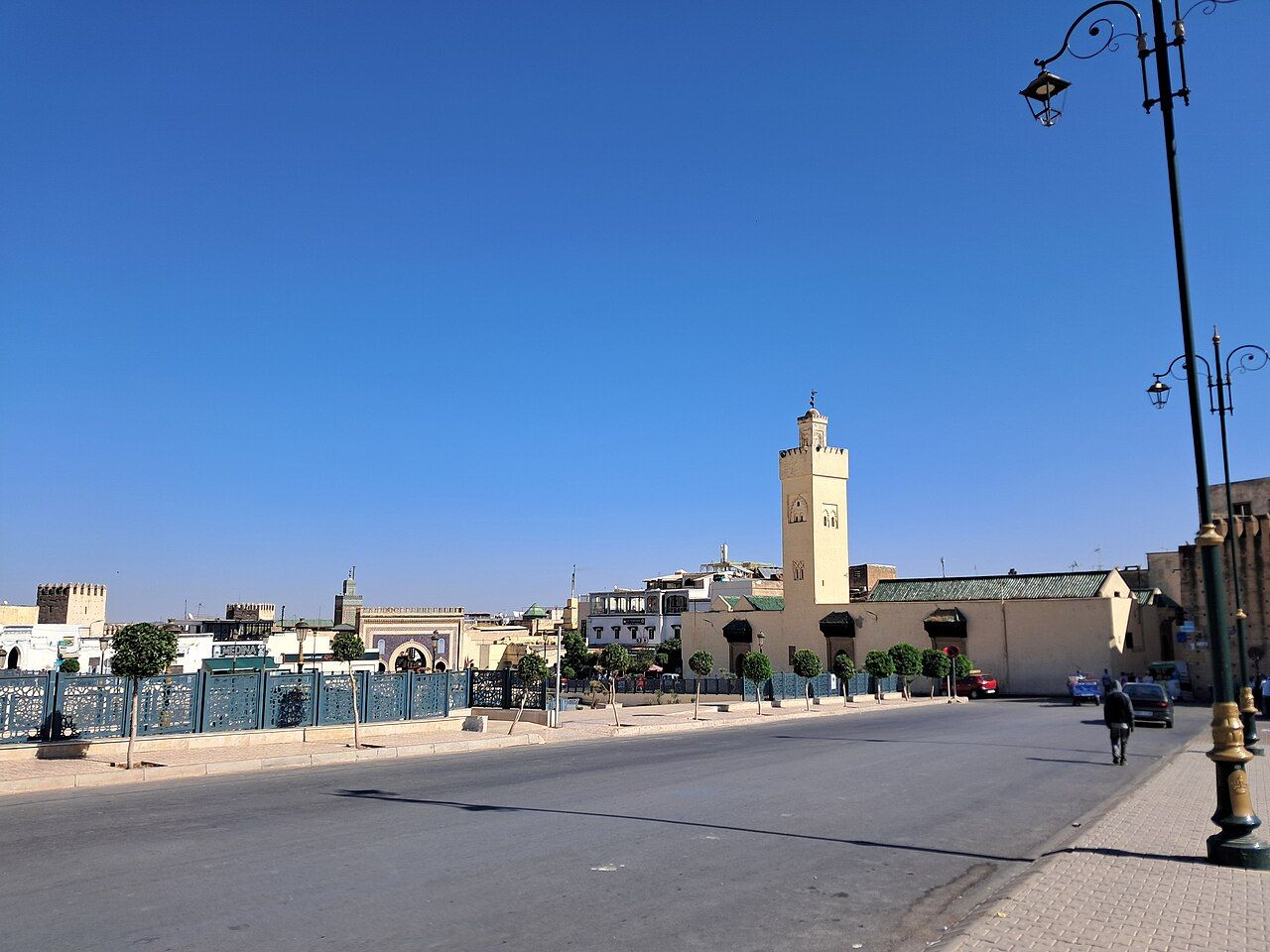
The open ground outside the gate is where the modern and the old city meet. Petit taxis drop passengers along the road nearby, and this is about as close as wheeled traffic gets to the heart of the medina. Beside the open ground, a large mosque with a square minaret stands among trees, and a short walk takes you to the shaded paths of the Jnan Sbil gardens and the old palace museum of Dar Batha.
The square is a useful meeting point and an easy landmark to return to if you lose your bearings. It is also where you are most likely to be approached by unofficial guides offering to show you the way. A friendly, firm "no, thank you" is enough; most people move on. If you want a guide, licensed ones can be arranged through official channels, and they carry identification.
Close by: Bissara, pastilla and the food of Fès
Two streets downhill: Talaa Kebira and Talaa Seghira
Pass through the gate and the ground immediately begins to fall away. Fès el-Bali sits in a valley, and almost everything you are likely to want lies downhill, towards the river and the great mosque of al-Qarawiyyin. Two main streets carry you there.
- Talaa Kebira, the "big climb", is the longer and more famous of the two. It starts just to the left of the gate's inner side, passes the entrance of the Bou Inania madrasa within a few minutes, and then runs for a long way through markets, past fountains and small mosques.
- Talaa Seghira, the "little climb", starts close by and runs roughly parallel, a little to the south. It tends to be slightly quieter and has its own run of shops and workshops.
The names describe the walk back up, which tells you something about the order of a day here. Going down is easy; the return is a steady climb. The two streets meet again lower down, close to the old spice market around the al-Attarine madrasa, so you can descend by one and come back by the other.
Just inside the gate the street is busy with food stalls, snack counters and juice sellers, and the smell of grilled meat and frying dough drifts out onto the square. This is the medina at its most crowded and most commercial. A few hundred metres in, the lanes settle into a quieter rhythm of craftsmen and neighbourhood shops.
The step from square to street is short, but the change is complete. Behind the gate there are no cars, the lanes narrow to the width of a loaded mule, and the noise of traffic gives way to footsteps, hammering and voices. It is worth pausing just inside to let your eyes and ears adjust before you head down.
Behind the gate there are no cars, the lanes narrow to the width of a loaded mule, and the noise of traffic gives way to footsteps, hammering and voices.
Using the gate well
Bab Bou Jeloud works best as both a starting line and a finishing post. Some practical points:
- Arrive early. In the first hours of the morning the square is calm, the light falls cleanly on the blue tiles, and shopkeepers are only beginning to open.
- Come back at dusk. Late afternoon and evening bring the busiest scene, when families stroll and the food stalls are at full stretch. The gate is lit after dark.
- Fix the slope in your head. If you get lost in the lanes, walking uphill generally brings you back towards this side of the medina. Our guide to finding your way in Fès el-Bali covers the rest.
- Start your sightseeing close by. The courtyard of the Bou Inania madrasa is only a few minutes down Talaa Kebira, and it makes a good first stop while you are still fresh.
- Dress modestly and ask first. Shoulders and knees covered is the norm in the medina, and it is polite to ask before photographing people, including stallholders.
Opening hours do not apply to a gate, but the life around it changes through the week and the year. Friday around midday prayers is quieter, and during Ramadan the square is calm by day and lively long after sunset.
What to notice on the way through
Most visitors walk under the arch in a few seconds, phone raised. Slow down. Notice the thickness of the wall, which hints at the defensive role city gates once played. Notice the worn wooden panelling at the base of the piers, polished by more than a century of shoulders and loads. Notice how the tile pattern changes between the outer field and the border, and how the plaster above is carved into small repeating niches.
Then step through and look back. The green face is calmer and often less crowded with people taking pictures. With the blue face behind you and the minarets ahead, you are standing on the threshold of one of the largest car-free urban areas in the world, and the rest of the city is a matter of walking downhill.