
Riads, gardens and Fès el-Jdid
Jnan Sbil, the green room between the two cities
Between the medina and the royal town lies a walled garden of fountains, palm avenues, bamboo and a slow pond, a cool place to walk off the lanes and breathe.
- From Bab Bou JeloudA few minutes' walk west
- PaceEasy
- The way inShort walk from Bab Bou Jeloud
- BringWater, a book, sun hat for midday
Fès el-Bali is a city of walls, shade and close-packed houses, and after a few hours in it your eyes start to want distance. Jnan Sbil gives you that. A short walk west of the medina, behind a long wall, the ground opens into fountain courts, straight avenues of cypress and palm, a grove of bamboo, and a pond where the light moves on the water. The place feels shared rather than grand, a garden for the whole city.
A royal garden opened to the city
Jnan Sbil sits in the strip of land between Fès el-Bali and Fès el-Jdid, the walled royal town built by the Marinids in the thirteenth century. For a long time it was a garden attached to the palace side of the city, laid out and extended by Alaouite sultans and watered from the river that runs through Fès. In the early twentieth century it was opened to the public, and it has been the city's park ever since.
The garden was restored in the early 2010s. Paths were relaid, fountains repaired, beds replanted and the old water channels cleared, and the result is tidy without being stiff. Families come at weekends, students revise on benches, older men talk in the shade, and couples walk slowly along the main axis. It is a working public space rather than a monument, so behave as you would in any city park.
The fountain courts
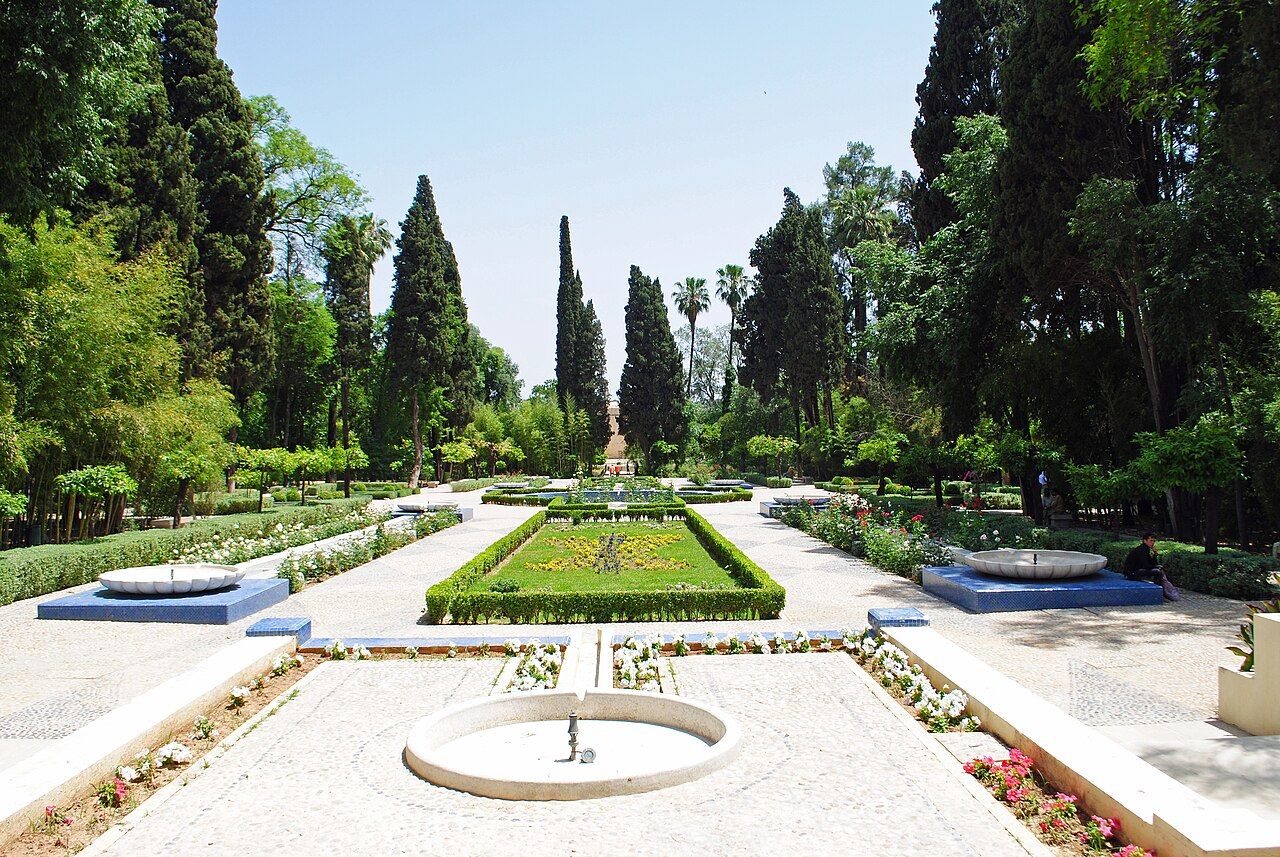
The formal part of the garden lies near the main entrance. Wide walks paved in small pebbles run between low hedges, with square beds of roses and seasonal flowers set inside them. Round fountain basins sit on tiled plinths at the crossings, and a line of them leads the eye down the central axis towards distant palms. On a bright morning the water, the pale paving and the dark cypresses make a strong pattern.
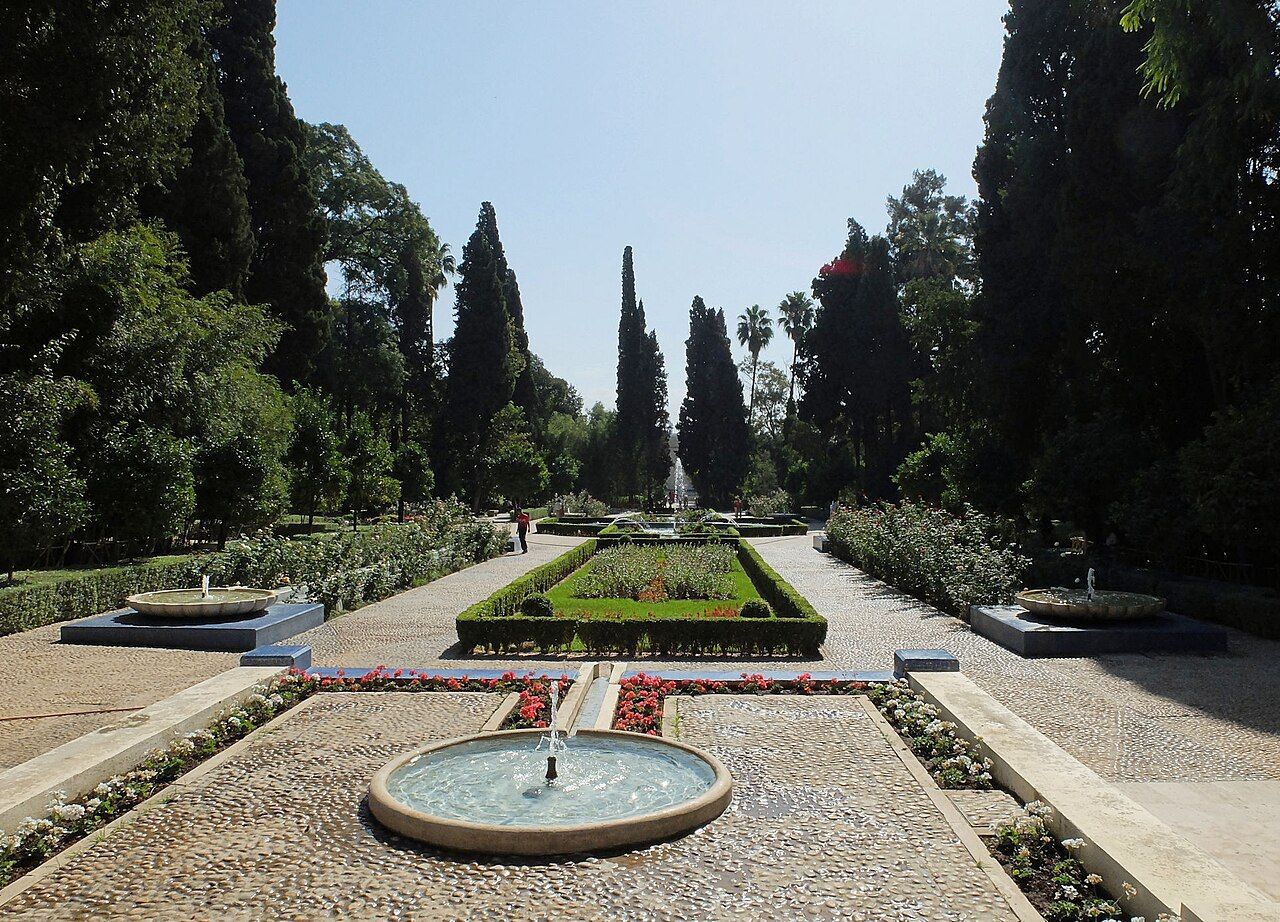
This layout follows a tradition you also see in palace courtyards across Morocco and in the garden at Dar Batha: water at the centre, paths crossing at right angles, planting kept low enough that the view stays open. The scale here is larger, and the effect is closer to a promenade than a private courtyard.
Water, wheel and pond
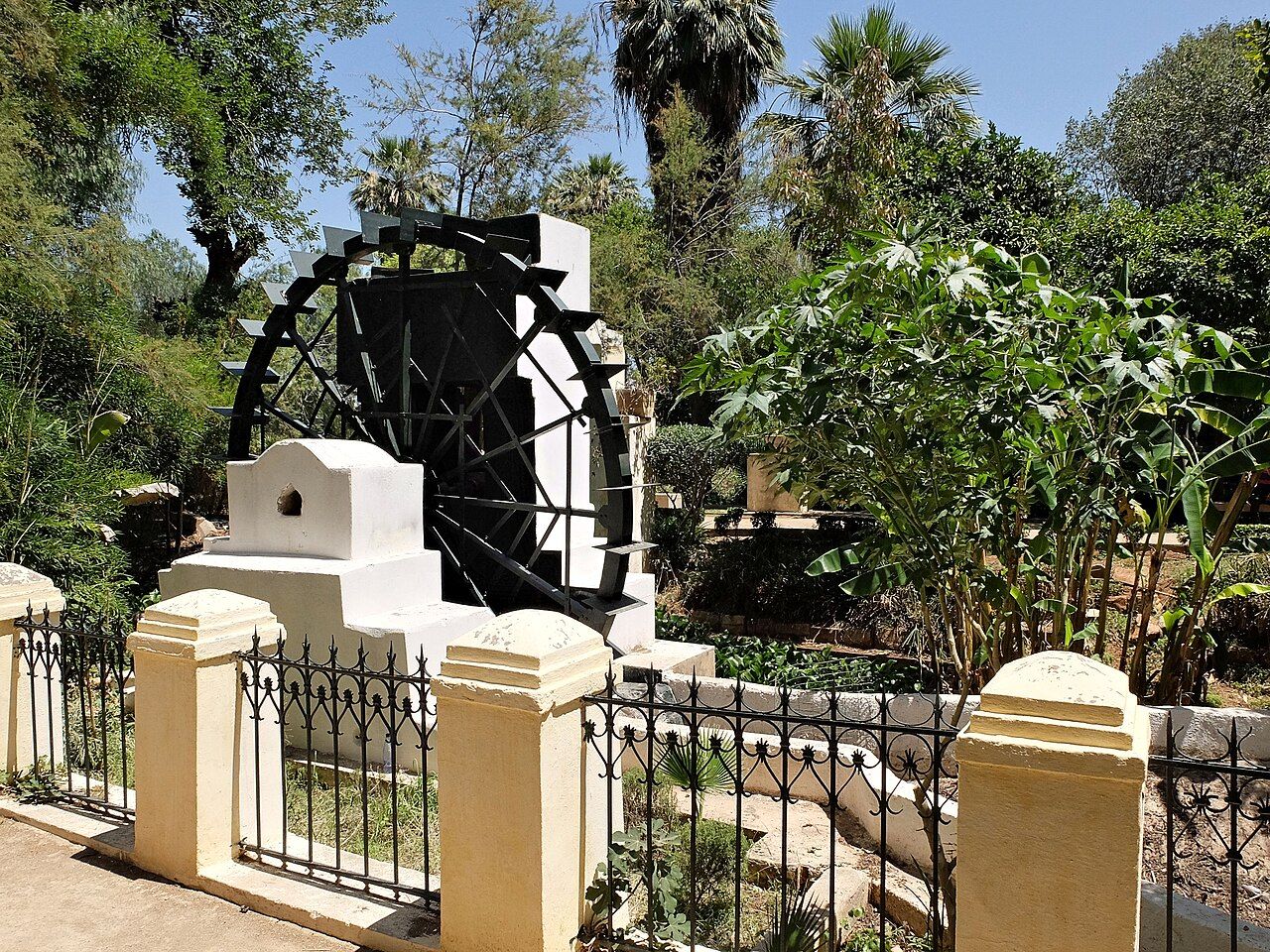
Water is the reason the garden exists. Channels fed from the river run through the grounds, and along one of them stands a large iron waterwheel, a noria, set on a whitewashed base behind a low fence. Wheels like this once lifted water into irrigation channels and to mills across the valley. This one lacks the buckets that would carry water up, so it seems to be kept as a reminder of the old system rather than a working machine, but it is good to see how such wheels were built.
Close by: Fès el-Jdid and the Mellah
Further in, the garden loosens. Paths curve around a pond fringed with palms and reeds, and ducks drift across it. The far sections hold denser planting, including a thicket of tall bamboo that creaks when the wind moves through it. These corners are where the garden feels most like a refuge, with the noise of the city reduced to a hum beyond the wall.
A walk through it
There is no set route, but an easy loop takes under an hour at a slow pace:
- Enter from the side nearest the medina and follow the central axis through the fountain courts.
- Bear off towards the water channels to find the waterwheel.
- Circle the pond, then wander into the bamboo and the shadier back sections.
- Return along a side path and sit for a while near the fountains before you leave.
You can also use the garden as a pleasant route between the two cities. From the medina side, the walk towards the Grand Rue of Fès el-Jdid and on towards the brass gates of the Royal Palace becomes much greener if you cut through the park on the way, depending on which gates are open.
Orange blossom in March
Spring is the best season. Roses, orange blossom and fresh green on the trees make March to May lovely, and the temperatures are kind for walking. Autumn is a second good season. In high summer, come early in the morning or late in the afternoon; the formal courts have little shade at midday, though the back sections stay cooler. Winter days can be crisp and clear, and the garden is quiet.
The gates are generally open during the day and close in the evening, but times shift with the seasons and around holidays. Fridays and weekends bring more families and a livelier feel.
Courtesy in a public park
Jnan Sbil is used by local people for rest, study and quiet courtship, which in a conservative city matters. A few simple habits keep things comfortable:
- Ask before you photograph anyone, and do not point a lens at couples on benches.
- Dress as you would in the medina; shoulders and knees covered is the easy choice.
- Keep off planted beds and do not pick flowers or fruit.
- Take your litter with you, and keep music to headphones.
Combine the garden with a slow walk back towards Bab Bou Jeloud and the square in front of it, and you have an easy, restful morning. It is also the right kind of pause between denser days, the moment in a trip to Fès when you sit by a fountain, hear water instead of hammers, and let the medina wait.