
Riads, gardens and Fès el-Jdid
Fès el-Jdid and the Mellah
The Marinids built a second walled city beside the old one. Its long Grand Rue, the Mellah's balconies and a hillside of white tombs tell a different Fès story.
- From Bab Bou JeloudTwenty-five minutes on foot, or petit taxi
- PaceHalf day
- The way inWalk via Jnan Sbil or petit taxi
- BringModest clothing, head cover for men at synagogues
Fès el-Jdid means "new Fès", which is a joke that has been running for about seven centuries. The Marinid sultans founded it in the late thirteenth century as a royal and military town beside the crowded medina, with its own walls, palace grounds, mosques and markets. Today it feels quieter and more spacious than Fès el-Bali, with longer straight streets and more sky. Inside it lies the Mellah, the historic Jewish quarter, whose architecture and cemetery make it one of the most moving walks in the city.
The Marinid new town
When the Marinid dynasty took Fès, they wanted a seat of power apart from the old city's merchants and scholars. Fès el-Jdid gave them that. The royal palace grounds took up much of the space, and around them grew barracks, gardens, administrative buildings and neighbourhoods for soldiers and officials. Later dynasties kept the town as the palace quarter, and the Royal Palace, Dar al-Makhzen, still occupies a huge walled area here.
The spine is the Grand Rue of Fès el-Jdid, a long straight street that runs roughly north to south between gates. It is lined with small shops selling clothes, household goods, fabrics and snacks, and it is mostly a street for local shopping rather than for souvenirs. Walking it gives you a clearer sense of everyday Fès than the busier lanes near the tanneries, and the pace is gentler.
The Mellah and its balconies
The Mellah of Fès is one of the oldest Jewish quarters in Morocco. In the fifteenth century the Jewish community was moved here from the medina to an area beside the royal palace, which offered both protection and control. The quarter grew dense and busy, with synagogues, schools, workshops and markets, and for centuries it was home to a large and learned community. Most of that community emigrated during the twentieth century, to Israel, France, Canada and elsewhere, and few Jewish families remain in Fès today.
The houses are what you notice first. Along the main street of the Mellah, often called the Rue des Mérinides, upper floors push out over the street on carved wooden balconies and wrought-iron balustrades with large windows. In the medina, houses turn blank walls to the lane and open onto a courtyard inside, a type described in our piece on the courtyard house; here many homes look outward. Some balconies are freshly painted and others are weathered and leaning, and the mix gives the street its character.
The Jewish cemetery
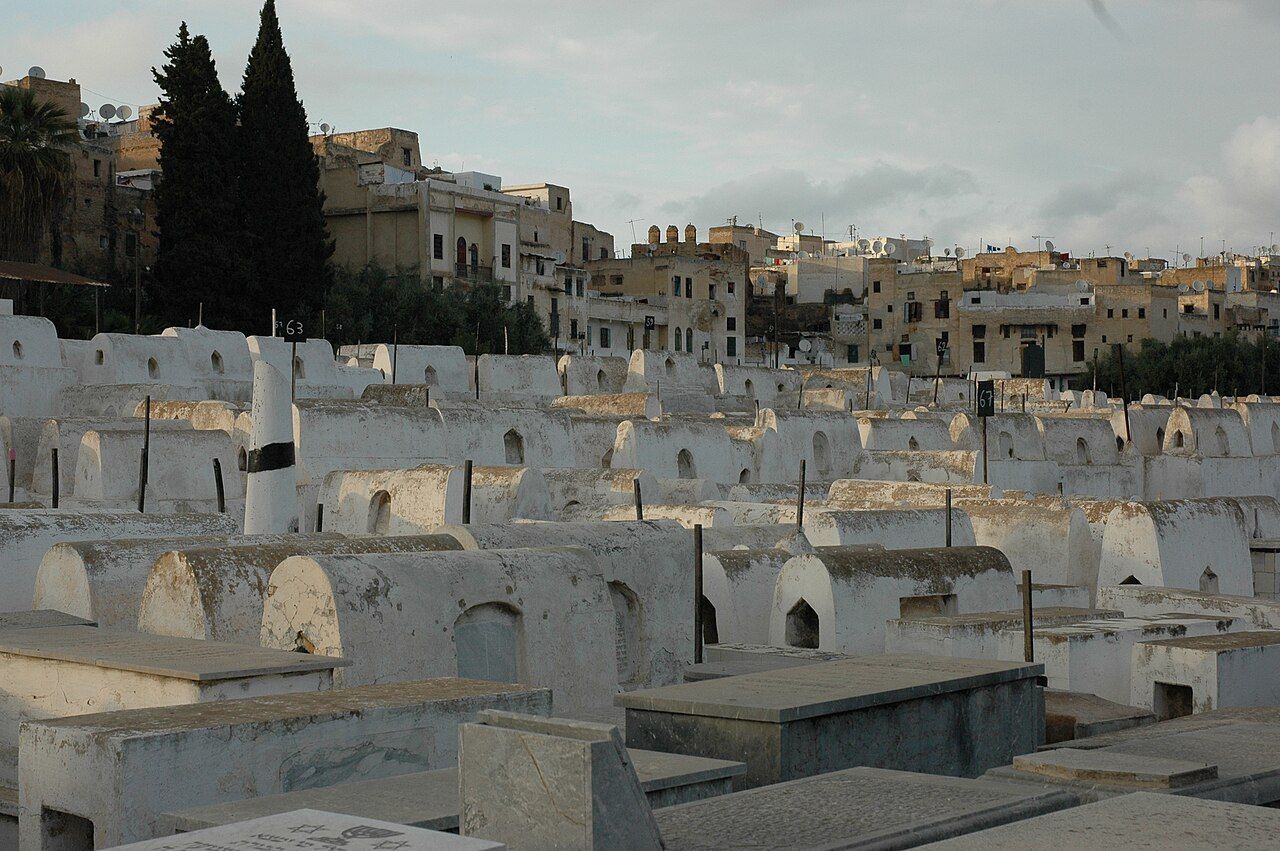
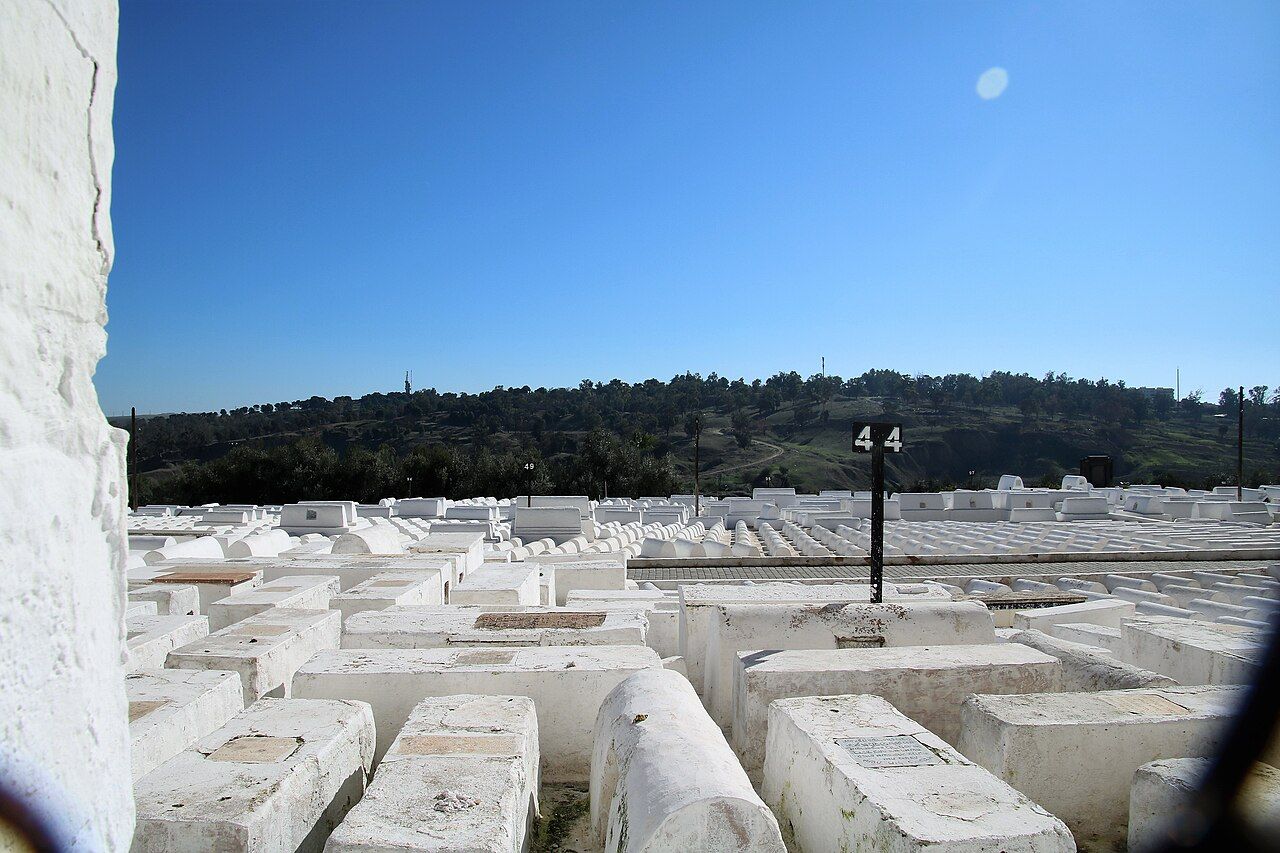
At the edge of the Mellah, on a slope facing the hills, lies the Jewish cemetery. From a distance it looks like a field of white: hundreds of tombs coated in lime, some flat, some rounded like barrel vaults, packed closely together in rows that follow the ground. Numbered posts and small plaques help families find their dead. Up close you see inscriptions in Hebrew, and on some graves French or Spanish names.
The cemetery has been carefully restored and is cared for by a keeper. Among the graves are tombs of rabbis and of people venerated by Moroccan Jews, and visitors from abroad still come to pray at them. There may be an entry donation or a fee, and the gate keeps set hours.
Close by: The brass gates of the Royal Palace
Walk slowly, keep to the paths between rows, and do not sit or stand on tombs. Photographs of the wider view are generally accepted, but avoid photographing anyone visiting a grave. Men may be asked to cover their heads in some areas.
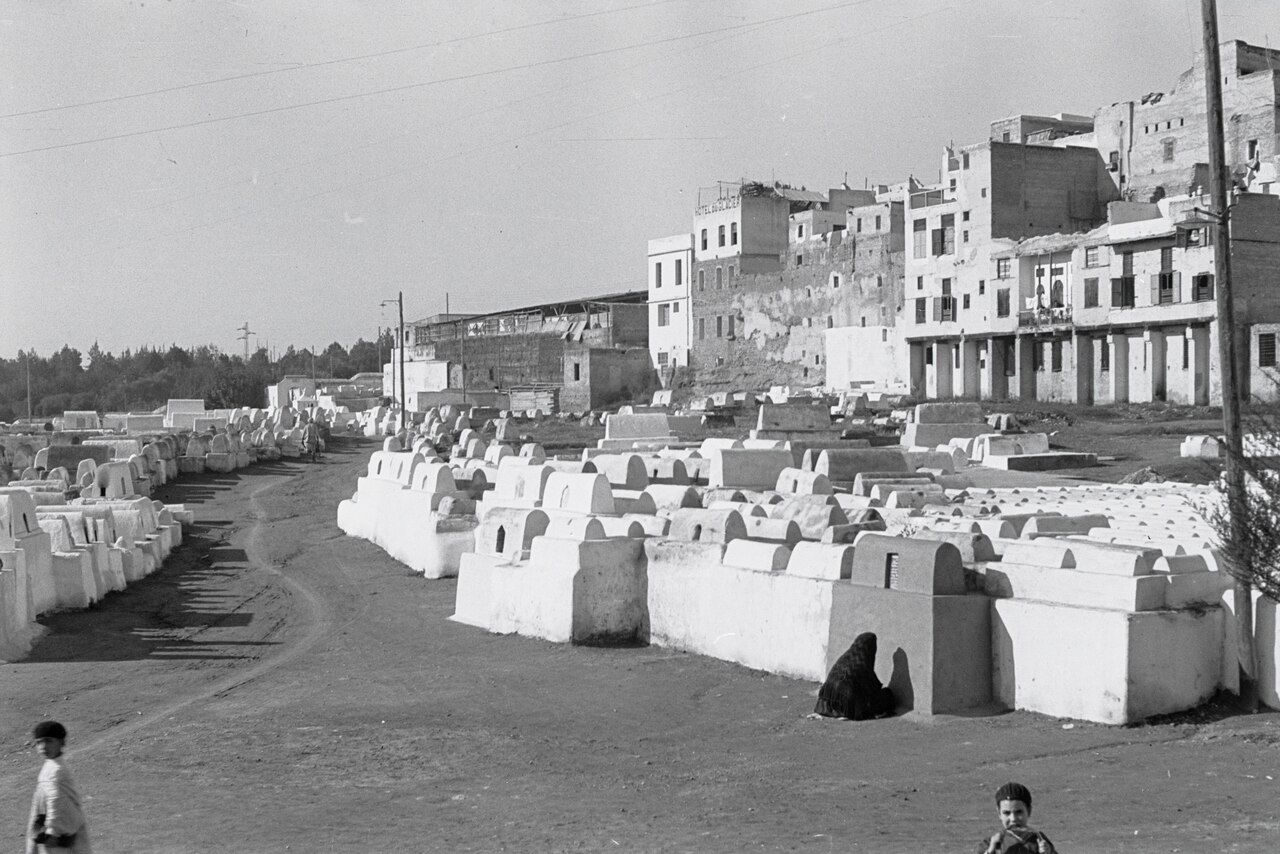
An old photograph taken in 1932 shows the same white tombs in a far more open setting, with houses of the Mellah rising behind a dirt road. Comparing it with the view today helps you see how the city has filled in around the cemetery while the rows themselves have stayed.
Synagogues told gently
Several synagogues once served the Mellah, most of them inside ordinary houses rather than in separate buildings. A few have been restored and can be visited, usually when a keeper is present. The best known is a seventeenth-century synagogue on a side lane, with a prayer hall of carved wood, painted ceilings, hanging lamps and a raised reader's platform. Another restored synagogue nearby has also opened to visitors in recent years.
Opening is irregular and depends on the person holding the keys, so ask politely in the quarter or at the cemetery gate. Dress modestly, offer a small contribution if one is requested, and remember that these are places of worship and memory before they are sights.
A half-day route
Most people combine the Mellah with the palace gates, which stand on a square right beside it. An easy order looks like this:
- Walk from Bab Bou Jeloud through or beside the gardens of Jnan Sbil, then south along the Grand Rue of Fès el-Jdid.
- Continue through the gate at the southern end into the Mellah's main street.
- Look up at the balconies, then follow signs or ask for the cemetery.
- Visit a synagogue if one is open, and finish on Place des Alaouites for the palace gates.
The walk from the blue gate takes around twenty-five minutes at an easy pace. A petit taxi is quicker, and useful for the return if your feet are tired.
Respect, quietly
The Mellah is a living neighbourhood, now largely Muslim, built on the memory of a Jewish city that shaped Fès for centuries. Treat it with the same care you would bring to any place of memory. Ask before photographing people, keep your voice low in the cemetery and synagogues, and resist any offer to be taken to a "special" shop in the name of a tour. Unofficial guides do approach visitors here; a polite, firm "no, thank you" is enough.
Above all, give the quarter time. The best moments are often small ones: the light catching a carved balcony, a jeweller's window on the main street, a keeper unlocking a door and switching on the lamps in an empty prayer hall.